Robots on the jobs people should not have to do.
What It Is
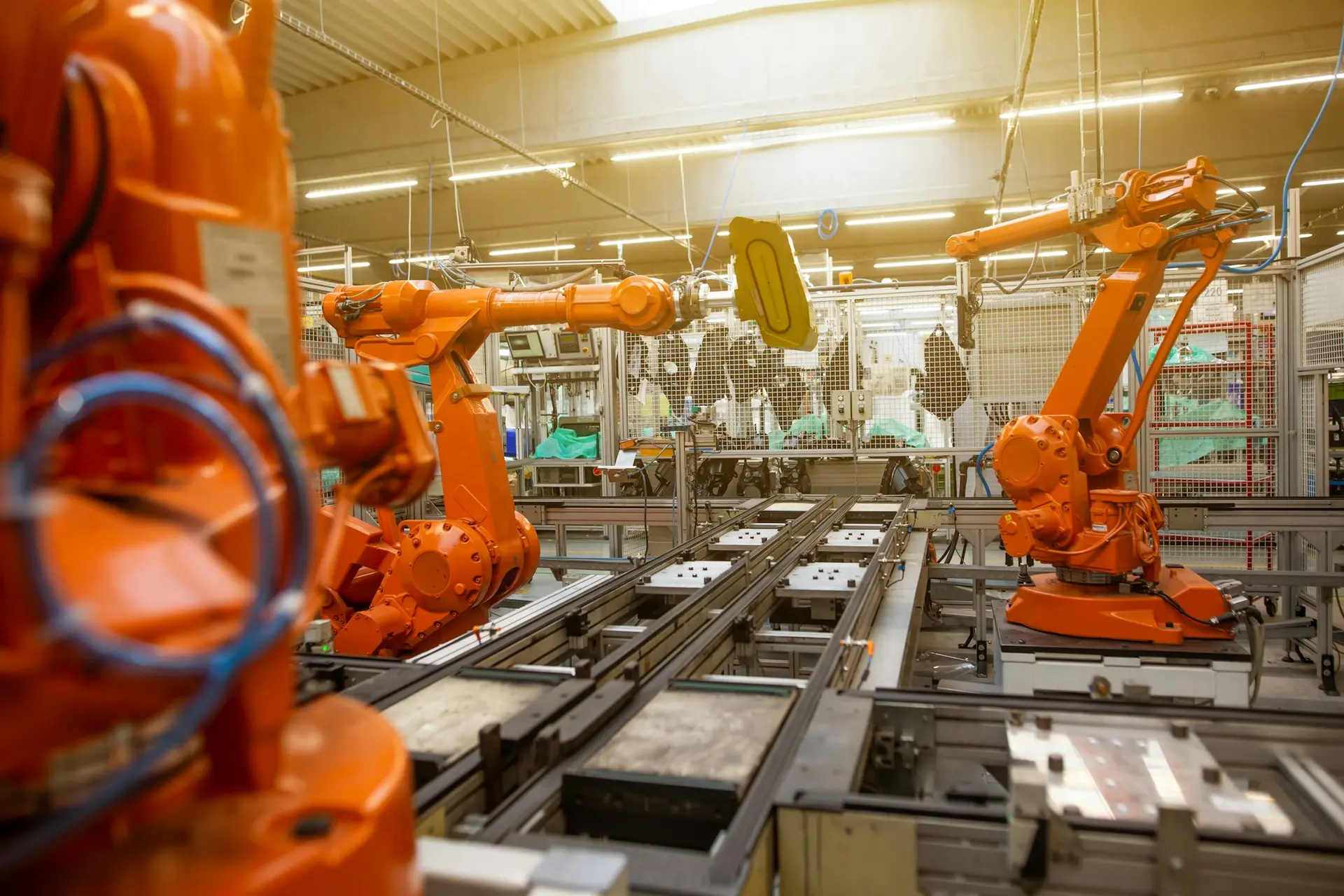
Industrial robots are fast, precise and strong, and work behind guarding. Collaborative robots (cobots) are slower but can work close to people after a risk assessment, which suits small batches and tight spaces.
Most of the engineering is around the robot: the gripper or welding torch, part presentation, vision guidance where parts are not fixed, safety design and the PLC that ties the cell to the rest of the line.
How It Works
The system from the sensor to the people who act on it. Every project is sized to the site, but the layers stay the same.
- Present
Part handling
Fixtures, conveyors or vision-guided picking bring parts to the robot.
- Act
Robot & tooling
A 6-axis robot, SCARA or cobot with the gripper, torch or dispenser for the task.
- Protect
Safety
Guarding, light curtains, safety scanners and a safety PLC sized from the risk assessment.
- Control
Cell PLC & HMI
Sequencing, recipes and interlocks with upstream and downstream machines.
- Report
Cell data
Cycle times, faults and counts sent to SCADA or MES.
Key Technologies
The protocols, standards and components we work with on this use case.
Robots
- 6-axis robots
- SCARA
- Cobots
- Vision-guided robotics
- End-of-arm tooling
Safety
- ISO 10218
- ISO/TS 15066
- ISO 13849
- ISO 12100 risk assessment
- Safety PLC
Engineering
- Offline programming
- Cell simulation
- PROFINET
- EtherNet/IP
- ROS 2
Typical Deliverables
What a project usually hands over. We agree the exact scope with you before work starts.
- Feasibility and cycle-time study
- Cell layout and simulation
- Tooling, fixtures and guarding design
- Robot and PLC programs
- Risk assessment and safety validation
- Installation, FAT/SAT and operator training
Where It Applies
Industries where this use case answers a problem we see often. Each links back to the sector page.
Related Use Cases
Vision inspection
Cameras and AI that check every part, pack and label at line speed.
Learn moreAMR & AGV material movement
Mobile robots that carry goods between zones, planned and integrated end to end.
Learn morePLC, SCADA & historians
Controls engineering and a live SCADA that ties the floor together.
Learn more
Let's Scope Your Project.
Tell us about your site and what you want to improve. Our engineers will help you scope a practical first step.